Site guide
Juno Beach and Sword Beach: A Visitor's Guide to the Canadian and British Sectors
Quick answer
Juno and Sword are the two eastern D-Day beaches, between Courseulles-sur-Mer and Ouistreham, 25 to 40 minutes from Bayeux or Caen. On Juno, see the Juno Beach Centre and the Canadian war cemetery at Bény-sur-Mer; on Sword, Hermanville and Ouistreham's Grand Bunker. Half a day covers Juno; a full day covers both.
| Fact | Detail |
|---|---|
| Juno Beach Centre hours | 10 a.m. to 5 p.m. in November and December; 9:30 a.m. to 7 p.m. from May to August; closed in January |
| Juno Beach Centre tickets | $10 / €9 adults; $15 / €13.50 with the guided bunkers tour (April to October); free under 8 |
| Bény-sur-Mer Canadian War Cemetery | 2,048 Second World War burials, most of them Canadian; open at all times, free |
| From Bayeux | Juno Beach Centre 23 km (14 mi), about 30 min; Ouistreham 45 km (28 mi), about 40 min |
| From Caen | Juno Beach Centre 22 km, about 25 min; Ouistreham 17 km, about 20 min |
| UNESCO | Juno and Sword are part of the D-Day Landing Beaches World Heritage Site since July 26, 2026 |
Juno and Sword are the two easternmost D-Day beaches. On June 6, 1944, Canadian troops landed on Juno, between Courseulles-sur-Mer and Saint-Aubin-sur-Mer, and British troops landed on Sword, at Hermanville-sur-Mer and Colleville-Montgomery, with the port of Ouistreham at its eastern end. Most American-focused tours skip this stretch. For Canadians it's the main reason to come, and with a second day on the coast it's the British and Canadian half of D-Day, which American-sector tours leave out.
Since July 26, 2026, both beaches are part of the UNESCO World Heritage Site "The D-Day Landing Beaches, Normandy, 1944", together with Utah, Omaha, Gold and Pointe du Hoc. Every hour, price and opening date below was checked against the official sites in November 2026.
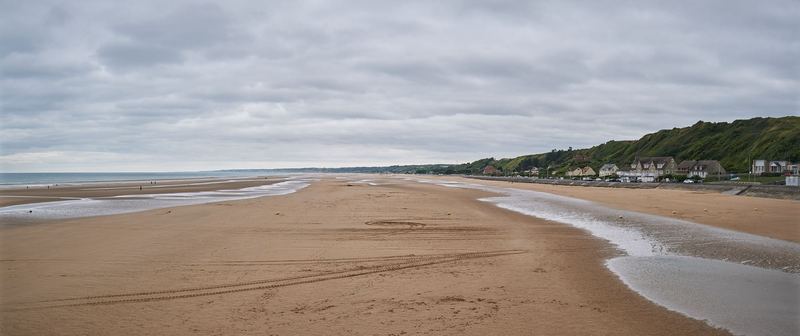
Juno is the most lived-in of the beaches: families, sailing boats and a working harbor, with the Juno Beach Centre and its Canadian flags at the edge of the sand. That ordinariness is the point.
Juno and Sword at a glance
| Juno Beach | Sword Beach | |
|---|---|---|
| Sector | Canadian | British (with French commandos) |
| Who landed | 3rd Canadian Infantry Division and 2nd Canadian Armoured Brigade, with the British 48th Royal Marine Commando on the left flank | British 3rd Infantry Division, Lord Lovat's commandos, and 177 French commandos under Philippe Kieffer |
| Towns on the beach | Courseulles-sur-Mer, Bernières-sur-Mer, Saint-Aubin-sur-Mer | Hermanville-sur-Mer, Colleville-Montgomery, Ouistreham |
| Key stops | Juno Beach Centre, Bény-sur-Mer Canadian War Cemetery, Maison des Canadiens | Hermanville War Cemetery, the commando memorials, Le Grand Bunker |
| Time to allow | Half a day | 2 to 3 hours |
The units and towns are from Normandie Tourisme. The times are my suggestions for a first visit.
Normandie Tourisme gives 21,400 Canadian and British troops for the Juno landings and 28,845 men landed on Sword that morning. The Juno Beach Centre counts 381 Canadians killed on D-Day and 5,500 in the Battle of Normandy.
Juno Beach Centre, Courseulles-sur-Mer
The Juno Beach Centre is Canada's Second World War museum in Normandy. It was opened in 2003 by veterans and volunteers, and it honors the 45,000 Canadians who died in the war. It stands right behind the beach at Courseulles, and its guides are young Canadians.

| Book | |
|---|---|
| Hours | February, November and December: 10 a.m. to 5 p.m. March, April, September and October: 9:30 a.m. to 6 p.m. May to August: 9:30 a.m. to 7 p.m. |
| Closed | All of January, and December 25 |
| Last tickets | 45 minutes before closing |
| Museum ticket (2026) | $10 / €9 adults; €7 reduced |
| Museum plus bunkers tour | $15 / €13.50 adults; €11.50 reduced |
| Bunkers tour only | €6 |
| Family pass | €27 for the museum, €42 with the bunkers tour (2 adults and up to 3 children over 8) |
| Free | Children under 8, Second World War veterans and their widows |
| Parking | Free on site, open only while the museum is open |
| Address | Voie des Français Libres, 14470 Courseulles-sur-Mer |
How long to allow. The centre recommends about 1.5 hours for the permanent exhibit and about 45 more minutes for the temporary one. Its 12-minute film, They Walk With You, runs at 15, 30 and 45 minutes past the hour; the last showing starts 15 minutes before closing.
The bunkers tour. From April to October, a Canadian guide takes you around Juno Park and inside two German bunkers opposite the museum, about 45 minutes, for ages 6 and up. In English it runs at 10:30 a.m. and 2:30 p.m. in spring and fall, and five times a day in July and August. Weather can cancel it.
Three things to know before you go.
- You can't take luggage or backpacks into the museum, for security reasons. Leave them in the car.
- If you come by train, bus or bike, ask for the low-carbon rate: €6 instead of €9. You need an SNCF ticket to a Normandy station bought in the past month, a NOMAD CAR 14 bus ticket validated the same day, or a photo of your bike in the centre's bike park.
- In winter, plan around the closure: the centre shuts for all of January.
What else to see on Juno Beach
The local tourist office, Cœur de Nacre Tourisme, lists bunkers and guns all along the beach. Beyond the museum, three stops are worth the short drive along the seafront.
Courseulles-sur-Mer. Besides the Juno Beach Centre, the tourist office lists German Tobruk shelters, a tank and a Cross of Lorraine here, and it calls Courseulles' harbor the first port in France to be liberated. The tall cross stands on the dunes just west of the museum, in Graye-sur-Mer. It marks General de Gaulle's return to French soil on June 14, 1944, on the beach between Courseulles and Graye-sur-Mer, according to the French Ministry of the Armed Forces.
Bernières-sur-Mer. On the seafront stands the Maison des Canadiens, which Normandie Tourisme describes as the first French house liberated on D-Day. The tourist office also points out the house used by the war correspondents. Bernières keeps many remains of the Atlantic Wall, and a 5 km discovery trail starts in the village.
Saint-Aubin-sur-Mer. The North Shore (New Brunswick) Regiment liberated Saint-Aubin; one in five of its soldiers was Acadian, Normandie Tourisme notes. The tourist office has a branch on the seafront, Digue Favreau.
The Maison des Canadiens is under 5 km (8 minutes) from the Juno Beach Centre. Cœur de Nacre Tourisme publishes a Juno Beach map with the sites marked.
Bény-sur-Mer Canadian War Cemetery
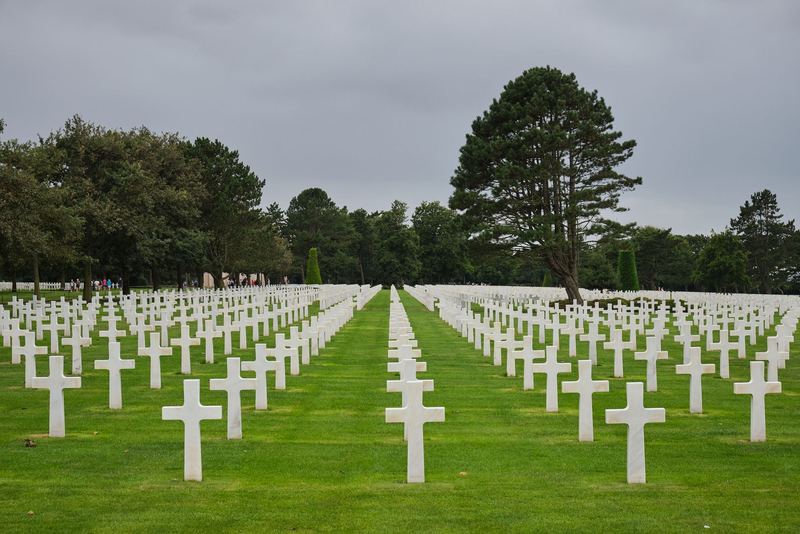
Despite its name, the cemetery is in the commune of Reviers, 4 km south of Courseulles. It's run by the Commonwealth War Graves Commission (CWGC). It contains 2,048 Second World War burials, the majority Canadian, 19 of them unidentified. Many of the men buried here belonged to the 3rd Canadian Division and died on June 6 or in the first days of the advance toward Caen, according to CWGC.

Getting there. The cemetery lies on the north side of the main road, 1 km east of Reviers, and the route is signposted. From the Juno Beach Centre it's 6 km, about 8 minutes. There's a lay-by in front for about five cars and a larger car park on the right-hand side.
Visiting. It's open at all times and free. The register box is in the left-hand shelter as you face the graves, and the two shelters have viewing platforms reached by stairs. The grass paths are flat and firm, according to CWGC's access notes. To look up a name before you go, use the "Find these casualties" search on CWGC's page for the cemetery. CWGC's free For Evermore app has a tour of the site and can scan a headstone to bring up that person's details.
Speak quietly and give families at a headstone their space: many visitors here come for one name.
Sword Beach: Ouistreham and Hermanville
Sword runs east from Hermanville-sur-Mer through Colleville-Montgomery to Ouistreham, at the mouth of the Orne. The British 3rd Division came ashore at Hermanville, and Lord Lovat's commandos, including Kieffer's 177 French fusiliers-marins, turned east to take Ouistreham, according to Normandie Tourisme.
Hermanville War Cemetery. Behind the beach, CWGC's Hermanville War Cemetery holds 1,003 Second World War burials, 103 of them unidentified. Many of those buried here died on June 6 or in the first days of the drive toward Caen. Drive north through the village, turn right after the church, and the gates are 300 meters along the Rue du Cimetière Anglais. There's parking right by the gate, and it's open at all times.
Colleville-Montgomery. On the Place du Débarquement, a statue of piper Bill Millin pays tribute to all the pipers, and pipers gather there every June 6, according to Caen la Mer Tourisme. Inland, on the road south to Biéville-Beuville, the Hillman site is a 24-hectare German command post with 18 casemates and a memorial to the 1st Battalion, Suffolk Regiment (Normandie Tourisme). Check its opening days before you go.
Ouistreham. Three stops sit close together near the seafront:
- Le Grand Bunker, Atlantic Wall Museum. A 17-meter concrete tower that was a German command post over the Orne estuary, rebuilt inside as it was in 1944, up to the rangefinder post at the top. Normandie Tourisme gives 1 hour 15 for the visit. Tickets are $10 / €8.50 for adults and €6.50 for ages 6 to 12, free under 6. It's open 9 a.m. to 7 p.m. from April to September, and 10 a.m. to 6 p.m. in February, March and from October to mid-November. From mid-November to mid-December it opens on weekends only, and its annual closure in 2026 ran from January 5 to February 7. Last entry is an hour before closing.
- The commando memorials. The memorial to the French commandos lists the names of the 177 who landed, next to ten stelae for the French soldiers killed on June 6 and a statue of Lord Lovat. On the Boulevard Aristide Briand, the Flame memorial has seven steps for the seven commandos who fell between the beach and the casino (Caen la Mer Tourisme).
- No. 4 Commando museum. A museum on the Place Alfred Thomas, facing the casino. It's seasonal: in 2026 it opened from February 7 to November 11, so it's closed until next February.
The ferry. Ouistreham is also the French port for Brittany Ferries' crossing from Portsmouth, which takes about 5 hours 45 minutes on average, according to the company. If you're arriving from England, Sword is your first D-Day beach.
Pegasus Bridge, next door
Pegasus Bridge is 7 km (9 minutes) inland from Ouistreham, on the Caen Canal at Bénouville. British glider troops took it intact just after midnight on June 6, 1944, hours before the beach landings. You can cross today's bridge at any time. The Mémorial Pegasus museum, which keeps the original bridge and a replica Horsa glider in its park, closed in fall 2026 for renovation, and the official reopening dates range from May to June 2027. Everything else is on my Pegasus Bridge page.

Getting there and parking
From Bayeux. It's 23 km (14 miles), about 30 minutes, to the Juno Beach Centre, and 45 km (28 miles), about 40 minutes, to Ouistreham. Gold Beach and Arromanches are on the way: the Juno Beach Centre is 13 km (17 minutes) from Arromanches.
From Caen. Caen is the closer base for this end of the coast. From the city center it's 22 km (25 minutes) to the Juno Beach Centre, 18 km (19 minutes) to Bény-sur-Mer and 17 km (18 minutes) to Ouistreham. Driving times are from OpenStreetMap routing with no traffic.
Between the two beaches. The Juno Beach Centre to Ouistreham is 23 km, about 27 minutes, along the coast road.
Parking. The Juno Beach Centre has a free car park, open during museum hours. Both CWGC cemeteries have parking at the gate. Along the seafronts of Courseulles, Bernières and Ouistreham, park where the signs allow and expect it to be busy in July, August and the days around June 6.
Caen station had nine rental locations on Discover Cars in November 2026, against one company in Bayeux, which makes it the easier place to collect a car for this end of the coast. My car rental in Bayeux or Caen page compares the two.
Compare rental cars in Caen on Discover Carsvia Discover Cars
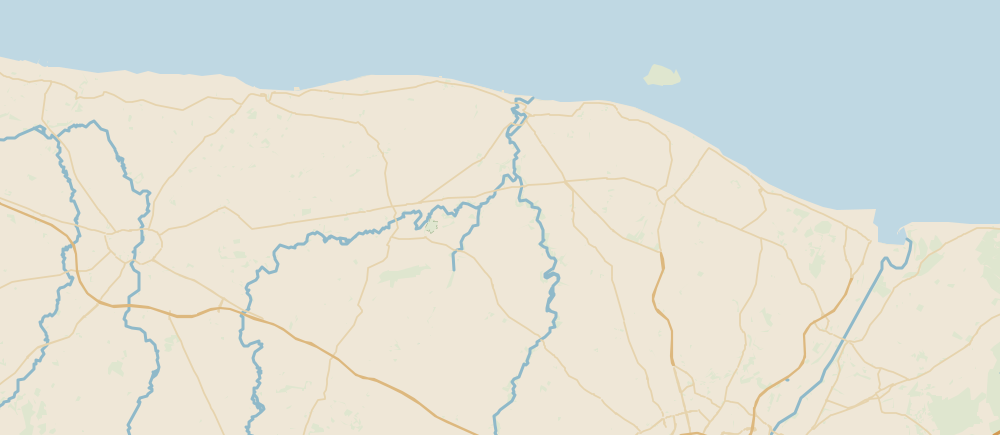
- 1Bayeux · 23 km (14 mi) to the Juno Beach Centre, about 30 min
- 2Bény-sur-Mer Canadian War Cemetery (Reviers) · Open at all times; 8 min from the Juno Beach Centre
- 3Juno Beach Centre, Courseulles-sur-Mer · Closed in January; free parking during opening hours
- 4Maison des Canadiens, Bernières-sur-Mer · On the seafront promenade
- 5Hermanville War Cemetery · Open at all times
- 6Piper Bill Millin statue, Colleville-Montgomery
- 7Le Grand Bunker, Ouistreham · Weekends only from mid-November to mid-December
- 8Pegasus Bridge · Bridge open; museum closed until spring 2027
Map data © OpenStreetMap contributors (ODbL)
Tours of the Canadian and British sectors
Most D-Day tours from Bayeux and Paris are built around the American beaches, so the choice for Juno and Sword is short. Prices as of November 2026:
| Tour | Starts from | What it covers | Length | Price from |
|---|---|---|---|---|
| Normandy Sightseeing Tour, Canadian battlefields full day (Viator) | Bayeux | Juno Beach, the Juno Beach Centre (1 hour, ticket included), Bény-sur-Mer, the Abbaye d'Ardenne, Carpiquet and Hill 67 | 8 hours | $150 / €133 |
| Blue Fox Travel, Juno Beach, bunkers and Canadian cemetery (Viator) | Paris | Juno Beach, Bernières, the Juno Beach Centre, Courseulles, Bény-sur-Mer and the Abbaye d'Ardenne; max 8 people | 12 hours | $269 / €240 |
| Mémorial de Caen, From Gold Beach to Caen (GetYourGuide) | Meeting point on the listing | A guided tour by the Mémorial de Caen from Gold Beach toward Caen | 4 hours | $168 / €150 |
Dollars at $1.1214 per euro (November 10, 2026), rounded. On Viator, the Normandy Sightseeing tour was rated 4.9 from 291 reviews and the Blue Fox tour 4.9 from 378 on November 15, 2026; the Mémorial's tour had 11 reviews on GetYourGuide.
From Bayeux, Normandy Sightseeing's day is built entirely around the Canadian sites, with an hour listed in the Juno Beach Centre and an hour at the cemetery. It picks up at Bayeux station, the Place de Québec and hotels.
Check dates for the Canadian full day from Bayeux on Viatorvia Viator
From Paris, Blue Fox's small-group tour is the Canadian-focused option, leaving at 7 a.m. from the Avenue des Ternes and returning about 12 hours later.
Check dates for Blue Fox's Canadian day from Paris on Viatorvia Viator
The Mémorial de Caen's own tours are compared on my D-Day museums page.
See the Mémorial's Gold Beach to Caen tour on GetYourGuidevia GetYourGuide
For American-sector days, see D-Day tours from Bayeux and D-Day tours from Paris. If you're looking for one Canadian or British grave, a private D-Day tour lets you build the day around it.
Where to stay for the eastern beaches
For Juno and Sword alone, stay in Caen or on the coast itself. Caen has the trains and the rental cars, and the Juno Beach Centre is 25 minutes away. If you're also seeing Omaha and the American Cemetery, Bayeux is the better compromise: about 30 minutes to Juno and under 30 to the cemetery. My picks for both towns are on where to stay in Normandy.
Fitting Juno and Sword into your trip
A day that works from Bayeux or Caen: the Juno Beach Centre at opening time, Bény-sur-Mer, lunch in Courseulles, then east along the coast to Ouistreham and Pegasus Bridge. For how this fits with the American sector, see visiting the D-Day beaches; the Mulberry harbor and Gold Beach are on Arromanches.
Frequently asked questions
Is the Juno Beach Centre worth visiting?
Yes, especially if you're Canadian or have Canadian family, and for anyone covering the British and Canadian beaches. It's the only Canadian museum on the D-Day coast, opened in 2003 by veterans and volunteers, and its guides are young Canadians. Allow 1.5 hours for the permanent exhibit, plus about 45 minutes for the guided tour of the bunkers in front of the building from April to October.
How long do you need at Juno Beach?
Half a day is enough for the Juno Beach Centre, a walk on the beach at Courseulles and the Canadian war cemetery at Bény-sur-Mer, 8 minutes inland by car. Add an hour if you also want Bernières-sur-Mer and Saint-Aubin. The centre itself recommends 1.5 hours for its permanent exhibit.
Where is the Canadian war cemetery in Normandy?
The main one for D-Day is Bény-sur-Mer Canadian War Cemetery, which is actually in the commune of Reviers, about 4 km south of Courseulles-sur-Mer and 18 km east of Bayeux. It lies on the north side of the main road, 1 km east of Reviers, and is signposted. It holds 2,048 Second World War burials, most of them Canadian, and it's open at all times.
Can you visit Juno and Sword in one day?
Yes. The Juno Beach Centre and Ouistreham, at the far end of Sword, are about 23 km apart, a 27-minute drive. Start at Juno when the centre opens, see Bény-sur-Mer, then drive east through Bernières and Hermanville to Ouistreham. Pegasus Bridge is 9 minutes beyond Ouistreham if you want one more stop.
Is Pegasus Bridge open?
The bridge is, but the museum isn't. You can cross today's Pegasus Bridge over the Caen Canal at any time. The Mémorial Pegasus museum, which keeps the original bridge in its park, closed in fall 2026 for extension and renovation work, and the official dates for its reopening range from May to June 2027.
Can you get to Juno Beach without a car?
Yes, but it takes planning. The Juno Beach Centre gives a lower 'low carbon' rate to visitors who show an SNCF train ticket to a Normandy station bought in the month before, a NOMAD CAR 14 bus ticket validated the same day, or a photo of their bike in the centre's bike park. Most people without a car take a tour from Bayeux or Paris.
Sources (22)
- Juno Beach Centre: practical information (hours, prices, parking, luggage)
- Juno Beach Centre: frequently asked questions (guided tours, visit length)
- Juno Beach Centre: home page (opening in 2003, Canadian losses)
- CWGC: Bény-sur-Mer Canadian War Cemetery, Reviers
- CWGC: Hermanville War Cemetery
- Normandie Tourisme: Juno Beach
- Normandie Tourisme: Sword Beach
- Normandie Tourisme: discovery trail of Bernières-sur-Mer
- Cœur de Nacre Tourisme: the Canadian sector, Juno Beach (easy-to-read guide, PDF, in French)
- Cœur de Nacre Tourisme: D-Day articles and Juno Beach map
- Chemins de mémoire (French Ministry of the Armed Forces): the French on June 6, 1944
- Caen la Mer Tourisme: experience June 6, 1944 on Sword Beach (memorials in Ouistreham and Colleville-Montgomery)
- Caen la Mer Tourisme: French-British Museum of No. 4 Commando
- Le Grand Bunker, Atlantic Wall Museum: hours and prices
- Brittany Ferries: routes and average crossing times
- UNESCO World Heritage Committee: decision 48 COM 8B.26, The D-Day Landing Beaches, Normandy, 1944 (July 26, 2026, in French)
- Viator: Normandy Sightseeing Tour, Canadian battlefields full day from Bayeux
- Viator: Blue Fox Travel, Juno Beach, bunkers and Canadian cemetery from Paris
- GetYourGuide: Mémorial de Caen, From Gold Beach to Caen
- Discover Cars: car rental in Caen
- OSRM (OpenStreetMap routing): driving distances and times
- European Central Bank: EUR/USD reference rate, November 10, 2026
Keep planning
Related guides