
Planning guide
Visiting the Normandy D-Day Beaches: A Practical Guide
Quick answer
Give the D-Day beaches one full day for the American sector, Utah and Omaha, and a second day if you want the British and Canadian beaches too. Sleep in Bayeux, under 30 minutes from the American Cemetery. Rent a car to set your own pace, or book a tour from Bayeux to have a guide explain what you're seeing.
The D-Day beaches stretch along the Normandy coast from the Cotentin peninsula in the west to the Orne River in the east, and the sites worth seeing are spread along all of it. Seeing them well is mostly a planning problem: which sector you care about, where you sleep, and how you get around: car or tour.
I drove the beaches on my own. This guide is what I'd tell a friend planning the same trip now, with every opening time, price and rule checked against the official sites in November 2026. The history is kept to what you'll see at each stop.

The Longues-sur-Mer battery at sunset.
Since July 26, 2026, the landing beaches are a UNESCO World Heritage Site. The listing, "The D-Day Landing Beaches, Normandy, 1944", covers Utah, Omaha, Gold, Juno and Sword beaches and Pointe du Hoc.
The five D-Day beaches at a glance
On June 6, 1944, American troops landed on Utah and Omaha, British troops on Gold and Sword, and Canadian troops on Juno. From west to east:
| Beach | Sector | What to see | Time to allow | Museum nearby |
|---|---|---|---|---|
| Utah | American | The beach, the landing museum by the beach, Sainte-Mère-Église inland | 2 to 3 hours with Sainte-Mère-Église | Utah Beach Landing Museum; Airborne Museum (Sainte-Mère-Église) |
| Omaha | American | The beach, the Normandy American Cemetery on the bluff, Pointe du Hoc to the west | Half a day with the cemetery and Pointe du Hoc | Overlord Museum (Colleville-sur-Mer) |
| Gold | British | Arromanches and the Mulberry harbor remains, the British Normandy Memorial, the Longues-sur-Mer battery just to the west | 2 to 3 hours | Musée du Débarquement (Arromanches) |
| Juno | Canadian | The beach at Courseulles-sur-Mer and the Juno Beach Centre | 1.5 to 2 hours | Juno Beach Centre |
| Sword | British | The eastern end of the landings, with Pegasus Bridge a short drive inland | 1.5 hours with Pegasus Bridge | Mémorial Pegasus (Ranville) |
The times are my suggestions for a first visit, not official figures.
Utah Beach
Full guide: Utah Beach guide.
The westernmost beach, on the Cotentin peninsula. The Utah Beach Landing Museum stands on the spot where the Americans came ashore and tells D-Day in ten sequences. It costs €10 (about $11) for adults and €6.50 (about $7) for children aged 6 to 15, with under-6s free. It's open every day from 10 a.m. to 6 p.m. from October to April and 9:30 a.m. to 7 p.m. from May to September, except for a winter closure from November 16 to December 14. Ticket sales stop an hour before closing.
Utah is the farthest beach from Bayeux: about 58 km (36 miles), 50 minutes by car.
Omaha Beach
Full guide: Omaha Beach guide.
Omaha is the beach at the center of most American-sector tours, and the one where you'll want the most time. It runs below a line of bluffs, with the Normandy American Cemetery at Colleville-sur-Mer on top. The cemetery is about 24 km (15 miles), 25 to 30 minutes, from Bayeux. The cemetery's own path down to the beach has been closed to the public since 2016 for security reasons, according to ABMC, so plan to drive down to the beach separately.
My dedicated Omaha Beach guide covers where to park and walk.
Gold Beach in Normandy
Full guide: Arromanches and Gold Beach guide.
The British sector's western beach is the one closest to Bayeux, which makes it easy to fit into the end of a day. The best-known town on this stretch is Arromanches-les-Bains, where the remains of the Mulberry artificial harbor still sit offshore. On a hillside overlooking Gold Beach at Ver-sur-Mer, the British Normandy Memorial records the names of the 22,540 servicemen and women under British command who died on D-Day and in the Battle of Normandy. It's free and open year-round; its Winston Churchill Centre is closed for the winter and reopens in April 2027.
Juno Beach, Normandy
Full guide: Juno and Sword Beach guide.
Juno was the Canadian beach. The Juno Beach Centre at Courseulles-sur-Mer was opened in 2003 by veterans and volunteers. It notes that 381 Canadians were killed on D-Day and 5,500 during the Battle of Normandy. From Bayeux it's about 23 km (14 miles), 30 minutes.
Sword Beach
Full guide: Juno and Sword Beach guide.
The easternmost beach, near Ouistreham. The usual reason to come this far is Pegasus Bridge, a few kilometers inland, and the Mémorial Pegasus museum at Ranville, which covers the British 6th Airborne Division. Pegasus Bridge is about 40 km (25 miles), 35 minutes, from Bayeux. The British and Canadian sectors get their own page: the British and Canadian D-Day beaches.
Which D-Day sites to prioritize
If you only see six places, make it these. They're listed west to east, the order you'd drive them on the route further down.

Sainte-Mère-Église
Inland from Utah Beach, this is the town of the American airborne landings; its Airborne Museum covers the paratroopers of the 82nd and 101st Airborne. The museum sits opposite the church bell tower where paratrooper John Steele was caught by his parachute. Check the museum's hours on its site before you go: they change with the season.
Pointe du Hoc
Full guide: Pointe du Hoc guide.
The cliff between Utah and Omaha that US Army Rangers scaled on D-Day. The ground is still pitted with bomb craters. Admission is free, and ABMC asks visitors to stay on the marked path.
Plan for restoration work if you go before mid-2027. The granite Ranger Monument on the point was taken down on June 17, 2026 and is in storage until it goes into a new memorial plaza, according to ABMC. ABMC began a major project in February 2026: the visitor center has been closed since March 9, 2026, most of the historic pathways and bunkers since mid-May 2026, and access is limited to the west pathway. The main parking area (P1) is closed until early 2027, so follow the signs to the temporary lot. The site is open daily; from October to March, ABMC lists a midday break from 12:30 to 1:30 p.m.
Normandy American Cemetery
Full guide: American Cemetery guide.
The cemetery holds 9,389 American service members, most killed in the landings and the weeks after, and the Walls of the Missing carry 1,557 names. It covers 172.5 acres above Omaha Beach and was dedicated in 1956. It's run by the American Battle Monuments Commission (ABMC).
What you need to know to visit:
- Hours: 9 a.m. to 5 p.m. daily, last admission 4:30 p.m., closed December 25 and January 1 (ABMC's visit page, checked November 2026).
- Cost: free.
- Reservations: not required today. ABMC expects free pre-registration to start at the end of 2026 for visits from summer 2027, for everyone including tour groups. Families of those buried there will still be able to visit when they choose.
- Visitor center: in the woods about 100 meters east of the Garden of the Missing. It's worth the time before you walk the rows.
Allow at least an hour. My American Cemetery guide has more detail.
Longues-sur-Mer battery
Full guide: Longues-sur-Mer guide.
Three of its four concrete casemates still house their original guns (the fourth is in ruins); France's Ministry of Culture records it as the only battery on the Normandy coast to have kept its guns, which makes it easy to read. It's free all year, and the tourist office says a visit takes about 30 minutes. The range-finding post on the cliff edge, the bunker that directed the guns, is closed for safety reasons. A 1 km heritage walk with eight signs starts from the tourist office.
Longues is 9 km (6 miles) from Bayeux, which makes it an easy last stop of the day. My photo at the top of this page was taken there at sunset. More in my Longues-sur-Mer battery guide.
Arromanches and the Mulberry harbor
Full guide: Arromanches guide.
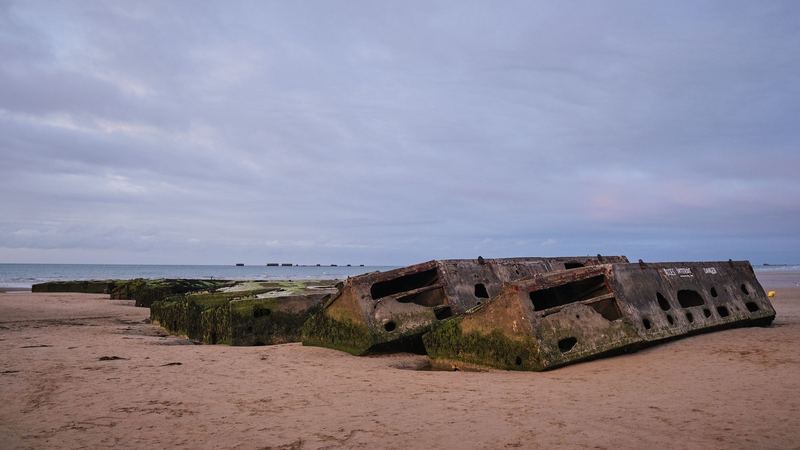
Arromanches is where the Allies built an artificial harbor after D-Day to land supplies without capturing a port. The concrete caissons that remain are still lined up offshore, and you can see them from the seafront and the cliff path. The Musée du Débarquement on the front explains how the harbor worked; in November 2026 its site listed 10 a.m. to 5 p.m., last admission 4:15 p.m.

Arromanches at sunset. The dark shapes on the horizon are what's left of the Mulberry harbor.
Pegasus Bridge
Full guide: Pegasus Bridge guide.
On the Caen Canal at Bénouville, British airborne troops under Major John Howard landed in Horsa gliders a few meters from the bridges before the beach landings and took both intact, according to the Mémorial Pegasus. The bridge you cross today replaced the original in 1994; the original stands in the museum park, with a life-size replica of a Horsa glider. It's the stop to add on a British-sector day.
La Cambe German war cemetery
Full guide: La Cambe German war cemetery.
Between Bayeux and Omaha, just off the N13, La Cambe holds 21,245 German war dead according to the German War Graves Commission (Volksbund). Entry is free. It's a sober contrast with the American Cemetery, and most tours that pass it stop for half an hour.
What US visitors tend to miss
Most of the tours from Bayeux in my comparison are sold as "American D-Day" tours, and they stick to Utah, Omaha, Pointe du Hoc and the cemetery. That's the right priority for most Americans, but it means the British and Canadian sectors, Arromanches and the Longues guns get skipped. If you have a car, ending the American-sector day at Longues and Arromanches adds well under an hour of driving. The museums are compared in my D-Day museums guide.
How many days do you need?
- Half a day: Omaha Beach and the American Cemetery, maybe Pointe du Hoc. This is what a half-day tour from Bayeux covers.
- One day: the American sector end to end, which is the route below.
- Two days: the American sector on day one, then Arromanches, the British Normandy Memorial, Juno Beach and Pegasus Bridge on day two, with the Mémorial de Caen if you like museums (it suggests about four hours for a full visit).
Two days plus a night or two in Bayeux is the comfortable version. If you're fitting the beaches into a longer trip, my Normandy itinerary puts them together with Mont-Saint-Michel and Giverny.
A 1-day self-drive route from Bayeux
Want two days instead? My 2-day self-guided route covers the American sector on day 1 and the British and Canadian beaches on day 2, stop by stop.

This loop covers the American sector west to east, so you end the day close to Bayeux, at Longues and Arromanches. Driving times are from OpenStreetMap routing with no traffic; time at each stop is my suggestion.
| Leg | Distance | Driving time |
|---|---|---|
| Bayeux to Sainte-Mère-Église | 56 km (35 mi) | 44 min |
| Sainte-Mère-Église to Utah Beach Museum | 15 km (9 mi) | 17 min |
| Utah Beach Museum to Pointe du Hoc | 41 km (25 mi) | 42 min |
| Pointe du Hoc to Omaha Beach (Saint-Laurent-sur-Mer) | 9 km (6 mi) | 12 min |
| Omaha Beach to Normandy American Cemetery | 6 km (4 mi) | 11 min |
| American Cemetery to Longues-sur-Mer battery | 15 km (10 mi) | 24 min |
| Longues-sur-Mer to Arromanches | 8 km (5 mi) | 11 min |
| Arromanches to Bayeux | 11 km (7 mi) | 15 min |
| Total | 160 km (100 mi) | about 2 h 55 min |
A workable schedule for a summer day:
- 8:00 a.m. Leave Bayeux.
- 8:45 to 10:00 Sainte-Mère-Église: the square and the church tower, then the Airborne Museum once it opens.
- 10:15 to 11:45 Utah Beach and its museum.
- 12:30 to 1:15 p.m. Pointe du Hoc (west path only until mid-2027).
- 1:15 to 2:15 Lunch near Omaha Beach.
- 2:15 to 2:45 Omaha Beach.
- 3:00 to 4:15 Normandy American Cemetery. Be inside before the 4:30 p.m. last admission.
- 4:45 to 5:15 Longues-sur-Mer battery.
- Evening Arromanches, then 15 minutes back to Bayeux.
In winter, drop Sainte-Mère-Église or move it to the end, check museum closures (the Utah museum closes from November 16 to December 14) and remember Pointe du Hoc's midday break.
I didn't time this exact loop, so treat the clock as a plan, not a record. The one real timestamp I have backs up the ending: my photo of the Longues-sur-Mer battery was taken at 8:20 p.m. and the one of Arromanches at 8:38 p.m., which is why the loop finishes on that stretch of coast. The order matters more than the minutes: the cemetery's last admission at 4:30 p.m. is the one fixed point of the day, and the end of the day goes to the two sites that don't close.
For the car, see car rental in Bayeux.
Compare rental cars in Bayeux on Discover Carsvia Discover Cars
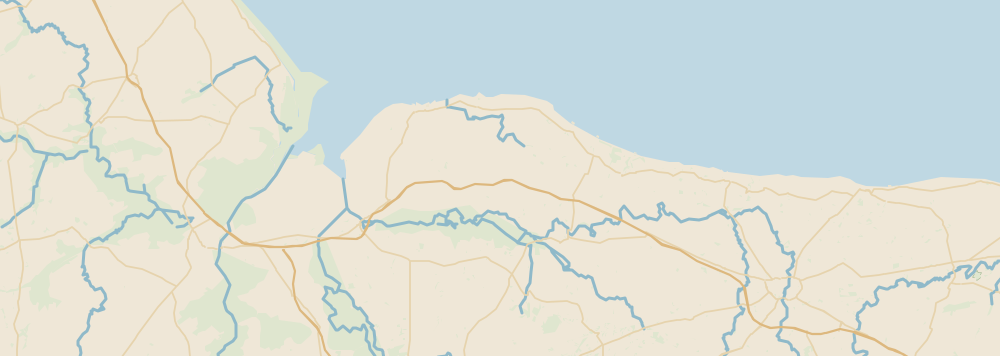
- 1Bayeux · Start and finish
- 2Sainte-Mère-Église · Church square and Airborne Museum
- 3Utah Beach Museum
- 4Pointe du Hoc · West path only until mid-2027
- 5Omaha Beach (Les Braves, Saint-Laurent-sur-Mer)
- 6Normandy American Cemetery · Last admission 4:30 p.m.
- 7Longues-sur-Mer battery
- 8Arromanches · Mulberry harbor remains; end the day here
Map data © OpenStreetMap contributors (ODbL)
Guided tour or self-drive?
Both work. The difference is what you value more: control over the day, or someone explaining what happened where you're standing.
Drive yourself if you're comfortable driving in France, you want to choose where to linger, or you want to add the British sector. Do some reading before each stop if you want the story behind what you're looking at.
Take a tour if you'd rather not drive, or you want a guide's account at Omaha and Pointe du Hoc. Tours from Bayeux spend the whole day on the coast. Some examples from my comparison, with prices and ratings from Viator on November 13, 2026:
- Bayeux Shuttle, Omaha Beach afternoon tour: from $99 / €88, rated 4.9 from 1,145 reviews.
- GoldBeachCompany, American and British beaches half day: from $107 / €95, rated 4.9 from 326 reviews.
- GoldBeachCompany, American D-Day beaches full day: from $157 / €140, rated 4.9 from 2,675 reviews.
- Bayeux Shuttle, American D-Day Experience full day: from $167 / €149, rated 5.0 from 1,761 reviews.
Check dates for GoldBeachCompany's full day on Viatorvia Viator
Check dates for Bayeux Shuttle's afternoon tour on Viatorvia Viator
The full side-by-side is on my D-Day tours from Bayeux page, and every type of tour, from Paris, Bayeux or private, is compared on Normandy D-Day tours. Families and groups of four or more should also look at a private D-Day tour.
Getting there from Paris
Bayeux is about 263 km (163 miles) from Paris by road, three hours without traffic. Direct trains from Paris Saint-Lazare take about 2 hours 15 minutes on the fastest services, and seat reservation is compulsory on the direct trains, according to EveryRail. Taking the train to Bayeux and renting a car there saves you the drive out of Paris.

If you drive out of Paris: the A13 Saint-Cloud tunnel, on the main motorway toward Normandy, is closed in the Paris-to-Normandy direction from November 16, 2026 to August 31, 2027, according to the Préfecture d'Île-de-France. Plan the detour before you set off.
If you only have a day and you're based in Paris, a day tour does the driving: City Wonders' D-Day day trip, for example, is from $118 / €105 and rated 4.8 from 10,662 reviews on Viator. Its listing gives 14 hours door to door. See D-Day tours from Paris for the comparison, and Paris to Normandy for train, car and tour side by side.
Arriving by cruise ship? Cherbourg is the closest port to the American sector and Le Havre the busiest: my guides to the Cherbourg cruise port and the Le Havre cruise port compare the shore excursions from each.
Where to stay: Bayeux as your base
Bayeux is close to everything on the American and British sides: 9 km from Longues, 11 km from Arromanches, about 24 km from the American Cemetery and 30 km from Pointe du Hoc. It also has its own sights, which my Bayeux guide covers.
To give you a price idea, here's what Booking showed on November 13, 2026 for the cheapest room for two adults on the night of June 15, 2027:
| Hotel | Price per night | Booking guest score |
|---|---|---|
| Campanile Bayeux | $121 / €108 | 7.7 |
| B&B Hotel Bayeux | $135 / €120 | 8.1 |
| Hôtel De Brunville & Spa | $187 / €167 | 7.8 |
| Château de Bellefontaine | $205 / €183 | 7.9 |
| Hotel Reine Mathilde | $212 / €189 | 8.7 |
Prices move a lot with the date, so check your own. My picks by budget are on where to stay in Bayeux.
Best time to visit, and the June 6 anniversary
From late spring to early fall the days are long, which matters on a self-drive day that ends at the coast. The museums I checked keep their longest hours from April or May to September.

Dates, ceremonies and hotel prices for the next anniversary are in the D-Day anniversary in Normandy.
The weeks around June 6 are different. Normandie Tourisme lists the 83rd anniversary events from May 29 to June 13, 2027, with commemorations on all five beaches and in Sainte-Mère-Église, Bayeux and Arromanches. Hotels fill up, and on the day itself the official ceremonies come first: in 2026, ABMC closed the American Cemetery's visitor center before, during and after the June 6 ceremony. Book rooms early and check ABMC's notices for the date.
In late fall and winter you'll have the beaches almost to yourself, with shorter days and some closures. Among the ones I found for this season: the Utah Beach museum closes from November 16 to December 14, the Mémorial de Caen is closed on several days in November and December 2026, the British Normandy Memorial's visitor center reopens in April 2027, and the American Cemetery closes on December 25 and January 1.
Visiting with kids, or as a veteran's family
With kids. The open-air sites work best: the guns at Longues-sur-Mer, the craters at Pointe du Hoc and the harbor remains at Arromanches are easy to understand without much explanation. The Utah Beach museum has a child rate (€6.50 for ages 6 to 15, free under 6). Keep the cemetery visit short and explain beforehand where you're going. In the reviews I sampled that say who was traveling, families wrote 36% of private-tour reviews but only 6 to 8% of group-tour reviews, so a private tour is worth a look; they're compared on my private D-Day tours page.
As a veteran's family. If a relative is buried or listed at the Normandy American Cemetery, find them first in ABMC's burial search on abmc.gov. ABMC says staff on duty can escort relatives to graves and memorial sites, and that group visits or wreath-laying ceremonies should be arranged with the cemetery by email in advance. Families of those buried there will be exempt from the pre-registration planned from 2027.
Etiquette at the cemeteries and memorials
ABMC describes its cemeteries as sacred burial grounds and asks visitors to behave with respect and solemnity. In practice: keep your voice down among the graves, keep children close, and save picnics and beach clothes for the beach. At Pointe du Hoc, stay on the marked path, both out of respect and because the cratered ground is uneven. Where an area is fenced off, like the range-finding post at Longues-sur-Mer, it's closed for safety.
Museums by age and how to explain D-Day to children: the D-Day beaches with kids.
Photographs are part of most visits. Take them, but give people at a grave their space.
More of the D-Day beaches from my visits
Arromanches 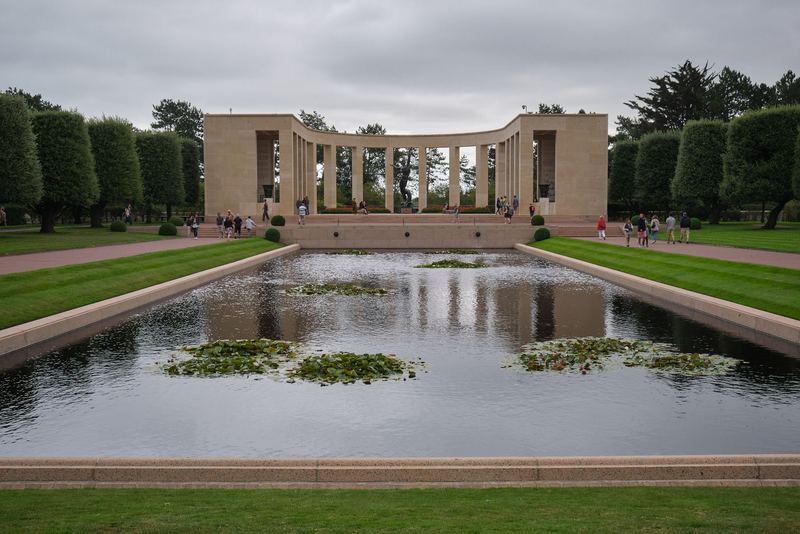
Normandy American Cemetery 
Bayeux


Frequently asked questions
How many days do you need to see the Normandy beaches?
One full day covers the American sector: Sainte-Mère-Église, Utah Beach, Pointe du Hoc, Omaha Beach and the American Cemetery. Add a second day for Gold Beach in Normandy, Juno Beach and Pegasus Bridge, or for a museum like the Mémorial de Caen, which says a full visit takes about four hours. Half a day is enough for Omaha and the cemetery only.
Can you visit the D-Day beaches without a tour?
Yes. The beaches are public, and the American Cemetery, Pointe du Hoc, the Longues-sur-Mer battery and the British Normandy Memorial are all free to enter. On your own you'll need a car to link the sites. Bayeux has rental cars and is the shortest drive to most of them.
Which D-Day beach should Americans visit?
Omaha Beach, with the Normandy American Cemetery on the bluff above it, is the beach most American-focused tours are built around. Utah Beach, where the other American landing took place, has the Utah Beach Museum on the sand. Pointe du Hoc, between the two, is where US Army Rangers climbed the cliffs on June 6, 1944.
What is the best town to stay in to visit the beaches?
Bayeux. By road it's about 24 km (15 miles) and 25 to 30 minutes from the American Cemetery, 9 km from Longues-sur-Mer and 11 km from Arromanches. It has direct trains from Paris Saint-Lazare, car rental and plenty of hotels.
Can you visit the Normandy beaches from Paris in one day?
Yes, on a day tour, but City Wonders' popular day trip, for example, lasts 14 hours, and a good part of that is on the road: Bayeux alone is about 263 km (163 miles) from Paris. Driving it yourself in a day is possible but tiring. If you can, sleep one night in Bayeux and see the beaches without the round trip.
Is there an entry fee for the beaches or the American Cemetery?
No. The beaches are free, and the Normandy American Cemetery is free and, according to ABMC, will stay free. ABMC expects to introduce free pre-registration at the end of 2026 for visits from summer 2027, for individuals, groups and tour operators. Families of those buried there won't need it. Museums such as the Utah Beach Museum charge admission (€10 for adults).
What is the best time of year to visit?
Late spring to early fall gives you the longest days and everything open. The weeks around June 6 are the busiest: Normandie Tourisme lists the 2027 anniversary events from May 29 to June 13. In winter some sites close or shorten hours, so check each one before you go.
Sources (19)
- UNESCO World Heritage Committee, decision 48 COM 8B.26 (July 26, 2026)
- ABMC: About Normandy American Cemetery (burials, missing, acreage)
- ABMC: Plan your visit to Normandy American Cemetery
- ABMC: Visiting Normandy American Cemetery (pre-registration)
- ABMC: Plan your visit to Pointe du Hoc Ranger Monument
- ABMC: Pointe du Hoc Ranger Monument restoration project
- Bayeux Bessin Tourisme: German battery at Longues-sur-Mer
- Utah Beach Landing Museum: hours and prices
- Juno Beach Centre
- British Normandy Memorial
- Musée du Débarquement, Arromanches
- Airborne Museum, Sainte-Mère-Église
- Mémorial Pegasus
- Mémorial de Caen: opening hours
- Normandie Tourisme: 83rd anniversary of D-Day, May 29 to June 13, 2027
- Préfecture d'Île-de-France: A13 Saint-Cloud tunnel closure from November 16, 2026
- EveryRail: Paris Saint-Lazare to Bayeux trains
- OSRM (OpenStreetMap routing): driving distances and times from Bayeux
- European Central Bank: EUR/USD reference rate, November 10, 2026
Keep planning
