Site guide
Arromanches and Gold Beach: The Mulberry Harbour and What to See
Quick answer
Yes, you can still see the Mulberry harbor: a few dozen of its concrete Phoenix caissons sit offshore at Arromanches, visible from the beach and from the cliff above town. Allow 2 to 3 hours for the seafront, the Musée du Débarquement (about 1.5 hours) and the 20-minute Arromanches 360 film. The British Normandy Memorial is 10 minutes east.
| Fact | Detail |
|---|---|
| Musée du Débarquement | €12.90 (about $14); 10 a.m.-5 p.m. Nov-Feb, closed in January |
| Arromanches 360 cinema | €7 (about $8); 20-minute film; closed Jan 4-25, 2027 |
| British Normandy Memorial | Free, open all year; small parking fee |
| From Bayeux | 12 km (7 miles), about 17 minutes by car |
| Longues-sur-Mer battery | 7 km (4.5 miles) west, about 10 minutes |
| Time to allow | 2 to 3 hours; half a day with the Memorial |
Arromanches-les-Bains is the small seaside town where the Allies built one of their two artificial harbors in June 1944. What's left of it, a line of concrete blocks out in the bay, is the reason most people stop here. In two to three hours you can see the remains from the beach and from the cliff, visit the museum that explains how the harbor worked and watch the 360-degree film above town. With half a day, add the British Normandy Memorial a few minutes east.
Every opening time, price and rule on this page was checked against the official sites in November 2026.
The Mulberry Harbour: what you can still see

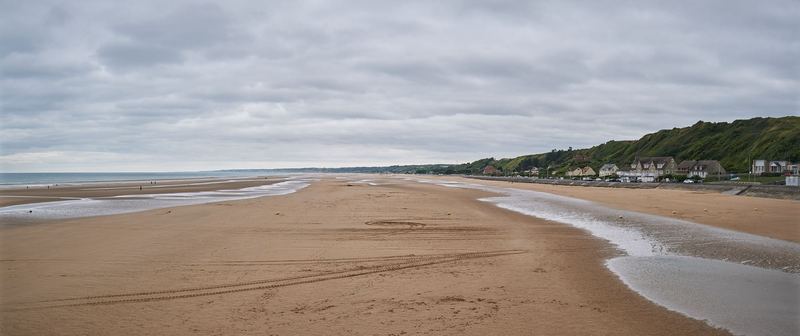
From Longues I drove down to Arromanches with little time to spare: I took this photo at 8:38 p.m., twelve minutes before sunset. The tide was out, and on the horizon the remains of the Mulberry harbor stood out against an orange sky. It's the image of Normandy I still carry with me.
The idea came out of a failure. After the Dieppe raid of August 1942, the Allies concluded they couldn't count on capturing a defended port in working order, so they decided to bring their own, according to the Imperial War Museums (IWM). The Musée du Débarquement says Allied planners expected to need at least 2,500 vehicles and 12,000 tons of supplies landed every day, and that 600 businesses and 50,000 people worked on the project in secret.
The harbors were built in parts and towed across the Channel. IWM describes the main pieces:
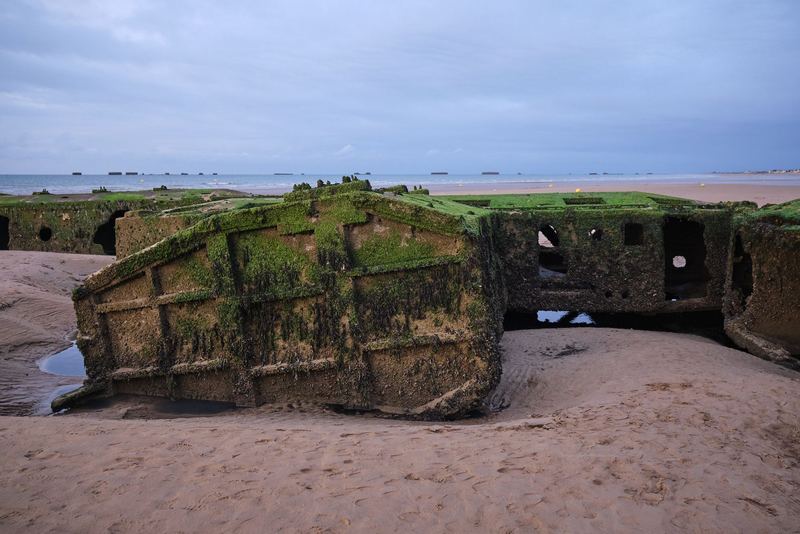
- Phoenixes: huge concrete caissons, sunk in a line to form the breakwater. These are the blocks you see today.
- Bombardons: floating steel sections chained together as an outer breakwater.
- Corncobs: old ships scuttled alongside the Phoenixes.
- Pier heads, "Whale" roadways and "Beetle" pontoons: the floating docks where ships tied up, and the flexible roadways on floating pontoons that carried cargo to the shore.
There were two harbors: Mulberry A off Omaha Beach for the Americans, and Mulberry B at Arromanches for the British and Canadians. According to Arromanches 360, which is run by the Mémorial de Caen, the first Phoenixes were sunk at Arromanches on June 8, 1944, and ships began unloading on June 14. On the night of June 19 to 20 a severe storm hit the coast. IWM says Mulberry A was judged too damaged to repair, and some of its parts were used to fix Mulberry B.
The Arromanches harbor, nicknamed Port Winston, kept working. Arromanches 360 gives its record as 400,000 soldiers, 4 million tons of equipment and 500,000 vehicles landed in 100 days, and says it remained in use until December 1, 1944.
Today a few dozen Phoenix caissons are still visible, according to Arromanches 360, and they still calm the water off the beach. You'll see them from the promenade, but the whole shape of the harbor, a long curve across the bay, makes more sense from the cliff on the east side of town (see the viewpoint below).
Practical info
Checked on the official sites in November 2026. Prices in dollars use the European Central Bank rate of November 10, 2026 (€1 = $1.1214), rounded.
| Musée du Débarquement | Arromanches 360 | British Normandy Memorial | |
|---|---|---|---|
| Where | Seafront, Place du 6 Juin 1944 | Clifftop, Chemin du Calvaire | Ver-sur-Mer, 13 Avenue Paul Poret |
| Hours now | 10 a.m. to 5 p.m. (Nov, Dec, Feb) | 10 a.m. to 5 p.m. | Open all year |
| Hours in summer | 9 a.m. to 7 p.m. (May to Aug) | Check the calendar | Open all year |
| Closed | Dec 24, 25 and 31; all of January | Mondays until Dec 14, 2026; Dec 25; Jan 1 and Jan 4 to 25, 2027 | Never (toilets close Dec 25, 26 and Jan 1) |
| Adult ticket | €12.90 (about $14) | €7 (about $8) | Free |
| Reduced | €8.30 (about $9), ages 6 to 18 | €6 (about $7), ages 10 to 18, students, over 65 | |
| Family | €37 (about $41), 2 adults + 2 children | €17 (about $19) | |
| Time needed | About 1.5 hours | 20-minute film | About 90 minutes |
| Parking | Town car parks | 500+ paying spaces, 150 m away | Small fee, free for blue badge holders |
| Wheelchair access | Yes, with lifts | Yes | Gravel paths from the car park, about 8 minutes |
A few rules worth knowing before you go:
- The museum sells tickets only at its own desk, which closes 45 minutes before the museum does. The audio guide is included.
- Strollers aren't allowed in the museum exhibition; there are lockers for them and baby carriers to borrow.
- Arromanches 360 sells tickets online and on site. Animals aren't allowed except assistance dogs.
D-Day Museum (Musée du Débarquement)
The Musée du Débarquement was the first museum built to remember the landings: President René Coty opened it on June 5, 1954, and it moved into a new building in 2023. It stands on the seafront, so the harbor remains are right outside its windows.
The visit is audio-guided, in 10 languages including English, and takes about an hour and a half. It covers both artificial harbors, the British and the American one, across seven sections with archive film and objects. The centerpiece is a set of scale models of the harbor at 1:50, made by the British model firm Bassett-Lowke and installed in the museum in 1955. They're 14 meters long in total, and one of them moves. There's also a children's audio guide for ages 6 to 10.
Practical points: it's accessible to wheelchair users, with two lifts to the first floor, and small dogs are allowed if carried. Photography is fine without flash.
Arromanches 360 cinema
Arromanches 360 is a circular cinema on the clifftop east of town, run by the Mémorial de Caen. The film lasts 20 minutes and is projected on nine screens around you, using British, Canadian, German, American and French archive footage. It covers the whole 100 days of the Battle of Normandy, not only the harbor. Screenings start every 20 or 30 minutes depending on how busy it is.

Children under 10 go free. If you're also going to the Mémorial de Caen, a combined ticket for both costs €24 (about $27).
Which one to choose? If you only have time for one, pick the Musée du Débarquement: it's the one that explains the harbor you came to see. Arromanches 360 is the shorter, cheaper option, and a good fit for kids or if you want the bigger picture of the campaign. Its car park is also the easiest way to reach the viewpoint, so many people do both.
Gold Beach and the British Normandy Memorial (Ver-sur-Mer)
Gold was the westernmost of the two British beaches. According to IWM, nearly 25,000 men of the British 50th Division landed there on June 6, 1944. Their objectives were Bayeux, the Caen to Bayeux road and a link-up with the Americans at Omaha. By the end of the day they had pushed about six miles inland and joined the Canadians from Juno Beach.
On a hillside above Gold Beach at Ver-sur-Mer, about 7 km (4 miles) and 10 minutes east of Arromanches, is the British Normandy Memorial. It was opened on June 6, 2021, and records the names of the 22,540 servicemen and women under British command who died on D-Day and during the Battle of Normandy, from more than 30 countries. The 1,746 who died on D-Day itself are on the D-Day Wall; the rest are on the columns in order of their date of death. The site also has a memorial to French civilians who died in the same months.
What to know:
- It's free and open all year. The car park charges a small fee, valid all day.
- From the car park it's about an 8-minute walk on compacted gravel, suitable for wheelchairs; some parts are on grass and can be slippery when wet. There's no staff on site full time.
- The Memorial recommends 90 minutes. Its free app has a map and audio guides, and helps you find a name on the columns.
- Drive in on the D514 coast road from Arromanches or Courseulles. The Memorial asks visitors not to approach the village from the south, where the roads are narrow.
- The Winston Churchill Centre next to the car park, with exhibitions, café and shop, reopens in April 2027.
Viewpoint above the town
The best view of the harbor is from the cliff on the east side of Arromanches, next to the orientation table and the Arromanches 360 cinema. From up there you can follow the line of caissons across the bay, which is hard to read from sea level. The municipal car park is right by it.

The other direction works too. From the Longues-sur-Mer battery, 7 km (4.5 miles) west, the interpretation panels point out the artificial harbor off Arromanches to the east. My Longues-sur-Mer battery guide covers that stop, and it pairs naturally with Arromanches: 10 minutes apart by car.
Tours that stop in Arromanches
Most tours from Bayeux stick to the American sector. These two include the Mulberry harbor at Arromanches; prices, ratings and itineraries from Viator on November 15, 2026:
- GoldBeachCompany, American and British D-Day beaches half day: from $107 / €95 as of November 2026, rated 4.9 from 326 reviews. It leaves Place du Québec in Bayeux at 1:00 p.m. and lasts about 5 hours: Omaha Beach (45 minutes), the American Cemetery (1 hour), the Longues-sur-Mer battery (15 minutes) and the Mulberry harbor remains (15 minutes).
- Bayeux Shuttle, British & American D-Day Experience: from $167 / €148.50 as of November 2026, rated 5.0 from 73 reviews. About 8 hours from 8:45 a.m., for up to 19 people: the Mulberry harbor (30 minutes), Longues-sur-Mer (20), Pointe du Hoc (45), Omaha Beach (30), the American Cemetery (40) and the British Normandy Memorial (40).
Neither listing includes time inside the Arromanches museums, so if the museum matters to you, a car gives you more time here.
Check dates for GoldBeachCompany's half day on Viatorvia Viator
Check dates for Bayeux Shuttle's British & American day on Viatorvia Viator
The Bayeux tours are compared side by side on D-Day tours from Bayeux.
Getting there and staying
By car. Arromanches is 12 km (7 miles) from Bayeux, about 17 minutes by road. It sits on the D514 coast road, 7 km east of the Longues-sur-Mer battery and 7 km west of the British Normandy Memorial. Driving times are from OpenStreetMap routing with no traffic.
If you're doing the beaches by car, Arromanches works well as the last stop of the day: the beach and the viewpoint don't close, and Bayeux is a short drive back. My self-guided driving route and the D-Day beaches planning guide put it in order with the other sites. For the car itself, see car rental in Bayeux.
Compare rental cars in Bayeux on Discover Carsvia Discover Cars
Without a car. Arromanches 360 says you can take the train from Paris Saint-Lazare to Bayeux and a regional bus from there. Buses on this coast are run by Nomad and aren't frequent, so check the current timetable on nomad.normandie.fr before you count on it.
Where to stay. Arromanches has a handful of hotels on and near the seafront, which suits anyone who wants the harbor at sunrise or sunset. Bayeux has far more choice and is closer to the American sector. My where to stay in Normandy page compares the two.
See hotels in Arromanches on Booking.comvia Booking.com
More museums along the coast are compared in my D-Day museums guide.
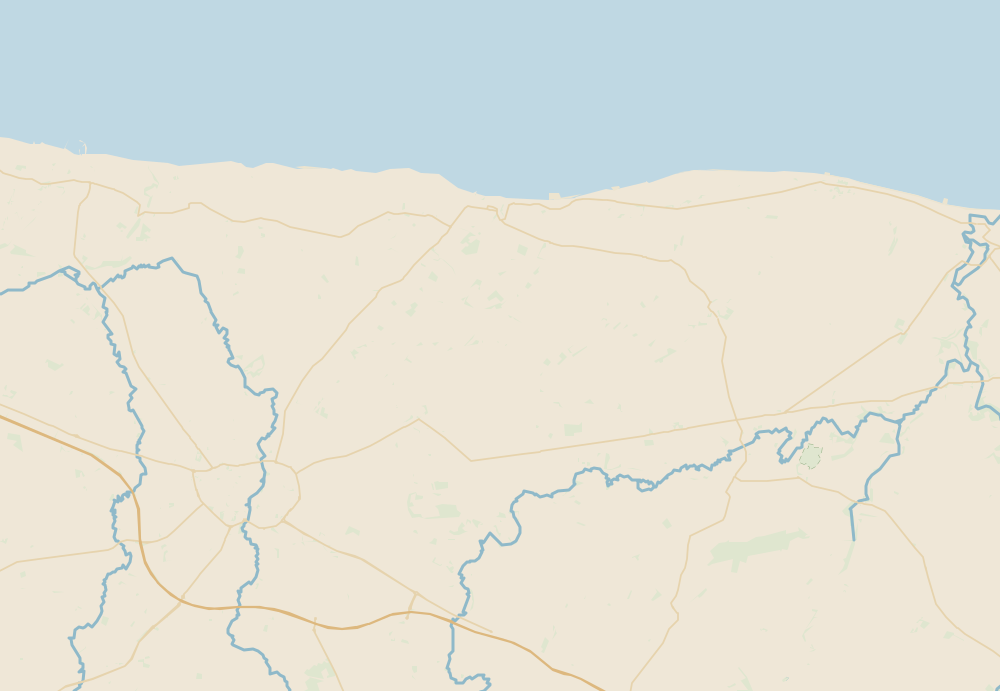
- 1Bayeux · About 17 minutes to Arromanches
- 2Longues-sur-Mer battery · Free, about 30 minutes
- 3Musée du Débarquement · On the seafront, facing the harbor remains
- 4Arromanches 360 · Clifftop cinema and viewpoint
- 5British Normandy Memorial · Ver-sur-Mer, free
Map data © OpenStreetMap contributors (ODbL)
More of Arromanches and Gold Beach from my visits
Arromanches 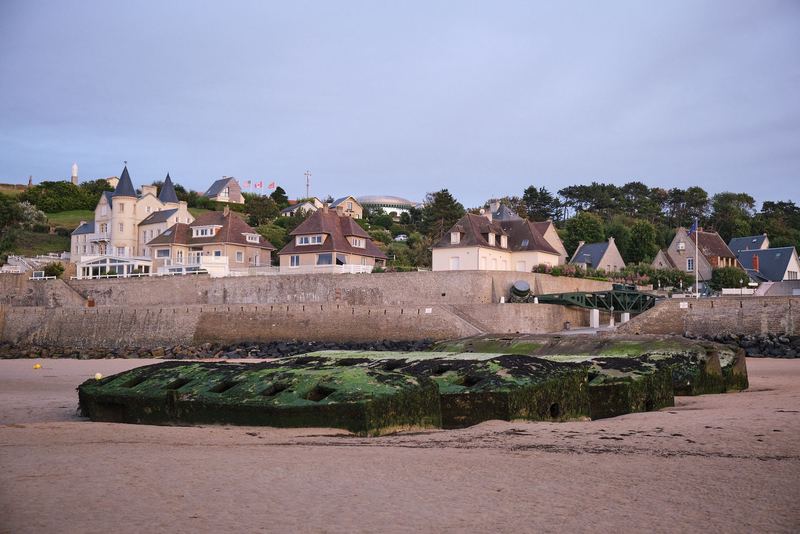
Arromanches


Frequently asked questions
Can you still see the Mulberry Harbour at Arromanches?
Yes. A few dozen of the concrete Phoenix caissons that formed the harbor's breakwater are still offshore, according to Arromanches 360, and you can see them from the seafront and from the cliff on the east side of town. The harbor, known as Mulberry B or Port Winston, stayed in use until December 1, 1944.
How long should you spend in Arromanches?
Two to three hours covers the seafront, the Musée du Débarquement and the Arromanches 360 film. The museum says an audio-guided visit lasts about 1.5 hours, and the film runs 20 minutes. Add about 90 minutes for the British Normandy Memorial at Ver-sur-Mer, which is the time the Memorial itself recommends.
Which museum should I choose, the Musée du Débarquement or Arromanches 360?
If you only have time for one, the Musée du Débarquement explains the harbor in detail, with working scale models and an audio guide, and sits right in front of the remains. Arromanches 360 is a 20-minute film on nine screens about the whole Battle of Normandy. It's cheaper and shorter, and the clifftop view outside is worth the stop on its own.
Where do you park in Arromanches?
Arromanches 360 says the municipal car park near the clifftop viewpoint has more than 500 paying spaces, 150 meters from the cinema, plus six free coach spaces. From there it's about 1 km by road down to the museum on the seafront. The Musée du Débarquement's accessibility page links to a town map of the car parks.
Is the British Normandy Memorial free?
Yes. The Memorial is free to visit and open all year. There's a small charge to use its car park, which goes toward upkeep, and blue badge holders park free. The Winston Churchill Centre, with exhibitions, café and shop, is closed for the winter and reopens in April 2027.
Is Arromanches on Gold Beach?
Yes. Arromanches is on the Gold Beach stretch of coast, where nearly 25,000 men of the British 50th Division landed on June 6, 1944, according to the Imperial War Museums. Arromanches was liberated that day, and the first Phoenix caissons were sunk offshore two days later, on June 8.
Sources (21)
- Musée du Débarquement: prices and opening times (2026 timetable)
- Musée du Débarquement: your visit
- Musée du Débarquement: FAQ (visit length, audio guides, tickets)
- Musée du Débarquement: accessibility and services
- Musée du Débarquement: history of the museum and the prefabricated harbors
- Musée du Débarquement: models of the port
- Arromanches 360 (Mémorial de Caen): admission tickets
- Arromanches 360: opening hours calendar
- Arromanches 360: getting here and parking
- Arromanches 360: the artificial harbour
- Imperial War Museums: Mulberry Harbours explained
- Imperial War Museums: What you need to know about the D-Day beaches
- British Normandy Memorial
- British Normandy Memorial: plan your visit
- British Normandy Memorial: FAQ
- British Normandy Memorial: getting here and parking
- British Normandy Memorial: accessibility
- Viator: GoldBeachCompany, American & British D-Day Beaches Half Day Tour from Bayeux
- Viator: Bayeux Shuttle, British & American D-Day Experience from Bayeux
- OSRM (OpenStreetMap routing): driving distances and times
- European Central Bank: EUR/USD reference rate, November 10, 2026
Keep planning
Related guides